Artificial Turf vs. Natural Grass in Austin: Honest 10-Year Cost Comparison
Why This Decision Hits Different in Austin
60+ days above 100°F in a bad yearThe national conversation about artificial turf vs. natural grass centers on aesthetics, environmental impact, and pet safety. In Austin, a different set of factors dominates: water cost, drought survival, and the brutal reality of what Central Texas summers do to turf.
Here's the Austin-specific picture:
Water restrictions are a real and recurring variable. Austin has entered Stage 2 water restrictions multiple times in the last decade. Stage 2 restricts outdoor watering to once a week per zone. Natural grass, particularly St. Augustine, which dominates South Austin lawns, cannot survive a Texas summer on once-weekly irrigation. It goes dormant at best, dies in patches at worst. After every severe restriction period, we're called to re-sod properties. Artificial turf has no irrigation requirement.
Austin's water rates compound over time. The City of Austin uses a tiered rate structure where the cost per gallon increases as usage increases. Homeowners with large irrigated lawns often hit the highest usage tier in summer, paying $7–$12 per 1,000 gallons for water beyond their base allocation. A 2,000 sq ft lawn watered at correct frequency in June–August can add $150–$300/month to a water bill in a drought year.
The clay soil wildcard. Austin's clay soil compacts over time, which degrades turf drainage and leads to patchy die-off even with correct irrigation. Natural grass on Austin clay needs regular aeration and sometimes total renovation every 7–10 years. Artificial turf is installed with a proper drainage base that addresses clay's drainage failure from day one, and that base doesn't degrade.
None of this means artificial turf is always the right answer. But it does mean the calculation is genuinely different here than in Seattle, Denver, or Atlanta.
Installation Cost: What You Actually Pay Upfront
$1.50–$3/sq ft sod vs. $12–$20/sq ft turfLet's start with the honest upfront numbers for a 1,000 sq ft lawn area in Austin in 2026.
Natural grass (sod) installation:
- Site prep (grade, soil amendment, tilling): $500–$1,200
- Sod material (St. Augustine or Bermuda): $600–$900
- Labor: $400–$700
- Irrigation system (if not already present): $2,500–$5,000
- Total for sod only (existing irrigation): $1,500–$2,800
- Total with new irrigation: $4,000–$7,800
Artificial turf installation:
- Excavation and base preparation: $1,500–$3,000 (critical, cannot skip on Austin clay)
- Geotextile weed barrier: $200–$400
- Decomposed granite or crushed stone base (3–4 inches): $800–$1,500
- Turf material (40–80 oz face weight, 15-year warranty product): $5,000–$10,000
- Labor and infill: $1,500–$3,000
- Total for 1,000 sq ft: $9,000–$17,900
The honest upfront gap: $7,500–$15,000 more for artificial turf. That's real money, and it's the number that makes most homeowners pause. The question is what that gap looks like when spread across 10 years, and whether the ongoing costs of natural grass close it.
A word on cheap turf installs: The base preparation is the most important part of an Austin turf installation and the first thing cut in a low-bid job. Austin's clay soil does not drain, if the turf is installed on compacted clay without a proper drainage base (3–4 inches of DG or crushed stone over geotextile), water will pool under the turf, the backing will break down prematurely, and the surface will become uneven within 3–5 years. We've replaced multiple "cheap" turf installs that failed for exactly this reason. The base is not optional in Austin.
Annual Costs: The 10-Year Math
$800–$2,000+/yr in water savingsThis is where the comparison gets interesting. Natural grass isn't cheap to maintain in Austin, and the annual costs add up significantly over a decade.
Natural Grass Annual Operating Costs (1,000 sq ft)
Water:
- Spring/fall: 2× per week irrigation, roughly 1,000 gallons/week = 12,000 gallons/season
- Summer: 3× per week minimum, 15,000–18,000 gallons June–September
- Annual water for lawn: 35,000–50,000 gallons
- At Austin tiered rates: $280–$500/year in water costs (more in drought years)
Maintenance:
- Mowing (professional service, every 2 weeks): $100–$175/month × 9 months = $900–$1,575/year
- Fertilizer (3× per year for healthy St. Augustine): $150–$300/year
- Herbicide/pesticide: $100–$200/year
- Aeration (annual recommended on Austin clay): $100–$200/year
- Annual maintenance total: $1,350–$2,275/year
One-time costs over 10 years:
- Re-sodding after drought damage (likely 1–2 times in 10 Austin years): $1,500–$3,500 each
- Irrigation repairs/upgrades: $300–$800
Natural grass 10-year total operating cost: $15,500–$28,000 (not including original install)
Artificial Turf Annual Operating Costs (1,000 sq ft)
- Water: zero (an occasional rinse for pets: $20–$50/year)
- Mowing: zero
- Fertilizer/pesticide: zero
- Infill top-up every 5–7 years: $300–$600
- Annual operating cost: effectively $0–$100/year
Artificial turf 10-year total operating cost: $300–$1,000
10-Year Total Cost Comparison
| | Natural Grass | Artificial Turf |
|---|---|---|
| Install | $1,500–$7,800 | $9,000–$17,900 |
| 10-yr operating | $15,500–$28,000 | $300–$1,000 |
| 10-yr total | $17,000–$35,800 | $9,300–$18,900 |
At the low end, costs are roughly comparable over 10 years. At the high end, drought years, water restrictions, re-sodding events, artificial turf is meaningfully cheaper over a decade in Austin's climate.
Performance in Austin's Climate: What Actually Happens to Each
Bermuda survives; St. Augustine struggles above 100°FCost is one thing. What does each option actually look like after 5 years in Austin?
Natural grass in Austin, the honest picture:
Bermuda grass is Austin's most drought-resilient natural option. It goes dormant (brown) in extended drought but recovers reliably when water returns. If you're OK with a brown lawn for weeks at a time in summer drought, Bermuda is a viable low-maintenance option. It handles heat well and is very competitive once established.
St. Augustine is the dominant Austin grass choice, it handles partial shade, stays greener longer, and has a lush dense appearance when healthy. But it's more irrigation-dependent than Bermuda, more susceptible to chinch bugs and brown patch fungus, and can die in extended drought without adequate water. On Austin's clay soil, compaction over time creates drainage issues that cause St. Augustine to thin and develop bare patches.
Zoysia offers excellent drought tolerance once established and a fine texture. It's slower to establish (often 2 seasons to fill in) and goes dormant in winter. Best for homeowners willing to wait for establishment.
What "natural grass in Austin" realistically looks like: Lush and green in April–May. Stressed and patchy in August. Bouncing back in September. Multiple re-sodding events over 10–15 years in shaded areas or areas where clay soil has compacted.
---
Artificial turf in Austin, the honest picture:
Year-round appearance: Stays green regardless of drought, water restrictions, or neglect. Never goes dormant, never browns.
Heat concern: This is the honest downside. In full Austin summer sun, artificial turf surface temperatures can reach 140–160°F, significantly hotter than natural grass. This makes it uncomfortable to walk on barefoot in full sun midday and problematic for young children playing on it. Turf installed in full-shade or partial-shade areas does not have this issue. Some newer "cool turf" products with heat-reducing infill (organic cork, sand) perform better than older crumb rubber products.
Drainage: A properly installed turf with a DG/gravel base over geotextile drains Austin rain events efficiently, even on clay. The key word is "properly installed." Without the drainage base, water pools under the turf.
Pet use: Artificial turf handles pet traffic extremely well, no mud, no dead patches from urine. Premium pet turf with antimicrobial infill and good drainage is one of the most common residential turf applications we install.
When Artificial Turf Is the Right Choice (and When It Isn't)
3 of 5 ACL turf installs are pet runs or shaded areasRather than declaring a winner, here's a direct framework for who should choose which.
Choose Artificial Turf When:
- You have a dog run or pet area. Dogs destroy natural grass, urine kills it, digging damages it, traffic compacts the soil. Artificial turf stands up to pet use, rinses clean, doesn't develop bare patches, and eliminates mud tracked inside. One of the most consistent value investments we see.
- You have a shaded area where grass won't grow. Most Austin grasses need 6–8 hours of sun. Shaded side yards, areas under large tree canopies, and north-facing spaces are chronic problem areas for natural grass.
- You're on Stage 2 water restrictions frequently. Turf eliminates your irrigation dependency entirely.
- Low maintenance is the primary goal. No mowing, no fertilizing, no irrigation scheduling. Vacation homes, rental properties, zero-maintenance homeowners.
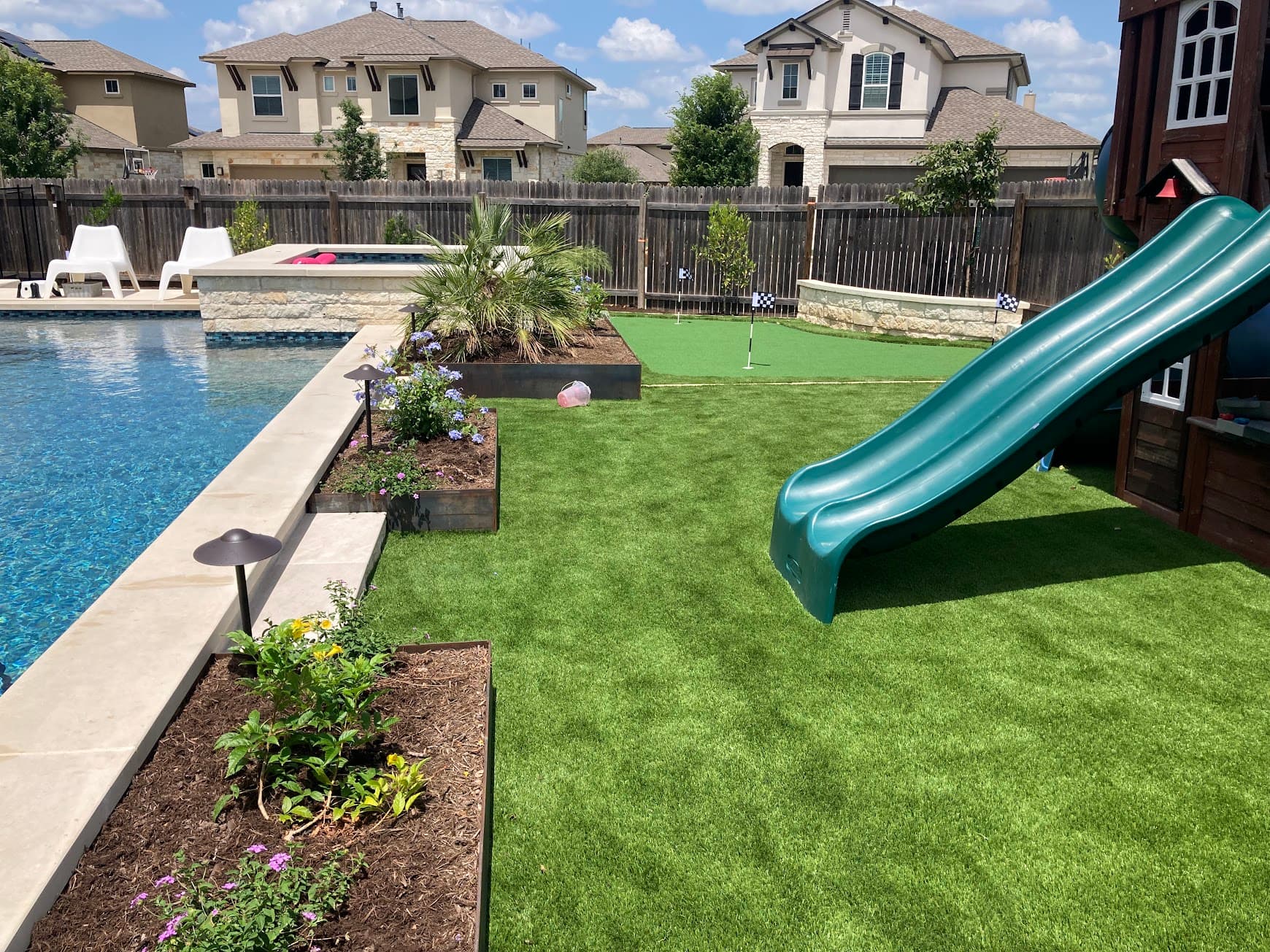
- You need a defined play surface. A 400–800 sq ft artificial turf patch as a dedicated kids' play area is cost-effective and extremely durable.
Stick with Natural Grass When:
- Kids will play on it in full afternoon sun. Surface temperatures in direct Texas sun can hit 150°F+. Natural grass (or shade structure over turf) is safer for young children playing midday.
- You want a large natural front lawn. A street-facing all-turf front yard can affect home resale perception in some Austin neighborhoods.
- You're on a slope needing erosion control. Natural grass root systems hold slopes far better than artificial turf.
- You have a strong environmental preference for living systems. Artificial turf doesn't support pollinator habitat, doesn't transpire to cool ambient air, and doesn't build soil biology.
See our full guide to drainage solutions, proper base drainage is critical to any quality turf install on Austin clay.
What a Quality Austin Artificial Turf Install Looks Like
15–20 year lifespan on a quality installIf you decide artificial turf is right for your property, here's what separates a quality installation from one that looks good for two years and fails.
Base preparation, the most important step:
Excavate 3–4 inches of soil. In Austin, this means going through the clay surface layer. Line the excavated area with a heavy-duty geotextile weed barrier. Fill with 3–4 inches of decomposed granite or crushed stone and compact it. This base allows water to drain through the turf and out through the porous material rather than pooling. Skipping this step on Austin clay is why cheap turf installs fail, water has nowhere to go, the backing saturates, and the surface becomes uneven within years.
Turf specification matters:
- Face weight: 40–80 oz per sq yard. Higher face weight = more realistic look, more durable.
- Blade height: 1.5–2.5 inches for lawn applications. Shorter for high-traffic areas like putting greens.
- Backing: Dual-layer polyurethane backing with drainage holes. Check that drainage holes are present, not all products include them.
- Infill: For standard lawn applications, silica sand and light rubber infill provides resilience. For pet applications, antimicrobial infill (ZeoFill or similar) helps manage odor. For heat reduction, organic cork infill runs cooler than rubber.
Seaming: Any area over about 15 feet wide will have seams. Quality seaming (hand-stitched, with seam tape and adhesive) is invisible when done correctly. Poor seaming becomes visible within 6–12 months.
What to ask any contractor:
1. What base depth are you installing and what material?
2. What is the face weight and manufacturer warranty on the turf?
3. How do you handle drainage on clay soil?
4. Can I see a recent install I can walk on?
5. Do you offer a workmanship warranty separate from the product warranty?
At ACL, we specify a minimum 50 oz face weight product with a minimum 12-year manufacturer warranty, always install over a proper DG base, and offer a workmanship warranty on our installations. Learn more about our artificial turf service.
Frequently Asked Questions
Is artificial turf worth it in Austin Texas?
How much does artificial turf cost to install in Austin TX?
Does artificial turf get too hot in Austin summers?
What grass type is best for Austin yards?
How long does artificial turf last in Austin?
Is artificial turf good for dogs in Austin?
Related Services
Related Articles
Not Sure If Turf Is Right for Your Yard?
We'll walk your property, look at sun exposure, drainage, and how you use the space, and give you an honest recommendation plus a real quote. No pressure, no upsell.
Head of Marketing, Austin Creative Landscaping