Caliche Soil in Austin: What It Is and How to Landscape Over It
What Caliche Is, And Why Austin Has So Much of It
6–36 in below surface, typical Austin depthMost Austin homeowners know about the heavy clay soil, we've all fought it. But there's a second soil challenge that shows up on a huge percentage of Central Texas properties, and it's one I think about on nearly every project I design: caliche.
Caliche (pronounced "kah-LEE-chee") is a calcium carbonate hardpan that forms in semi-arid soils over thousands of years. As rainwater slowly percolates through alkaline soil, it dissolves calcium carbonate and carries it downward. As the water evaporates in Austin's heat, the calcium carbonate redeposits and, over millennia, accumulates into a cemented layer. The result is a rock-hard or chalk-hard layer of essentially calcium cement sitting anywhere from 6 inches to 3 feet below your topsoil.
The Hill Country and Western Balcones Escarpment geology that underlies much of Austin is particularly prone to caliche formation. The combination of shallow alkaline soils, periodic rainfall, and long dry periods creates ideal caliche conditions. You'll find it most commonly in:
- Southwest Austin (Oak Hill, Circle C, Bee Cave corridor)
- Northwest Austin (Anderson Mill, Four Points, Jollyville)
- The Cedar Park, Round Rock, and Georgetown corridor
- Older neighborhoods where the original topsoil has eroded over decades
Two forms you'll encounter:
- Powdery/chalky caliche: A soft, white, crumbly layer that can be broken with a shovel. More workable, still restricts drainage and roots.
- Cemented caliche: A dense, concrete-like layer that rings like rock when you hit it with a shovel. Requires mechanical breaking. This is the version that makes landscapers curse.
How to tell the difference from limestone bedrock: Caliche is typically softer than true limestone, often layered or mottled rather than solid, and reacts (fizzes) to acid. Pour a few drops of vinegar on a sample, vigorous fizzing confirms calcium carbonate. True Austin limestone will have minimal reaction.
What Caliche Does to Your Landscape
Near-zero drainage rate through dense calicheCaliche doesn't kill plants immediately. It kills them slowly, in ways that look like other problems, overwatering, underwatering, nutrient deficiency, disease. I've diagnosed caliche as the root cause of "mysterious plant death" on dozens of Austin properties.
How Caliche Kills Drainage
Dense caliche is essentially impermeable. Rainwater or irrigation water percolates through the topsoil, hits the caliche layer, and has nowhere to go. It backs up above the caliche and saturates the root zone, creating exactly the anaerobic conditions that cause root rot, even in plants that otherwise want good drainage. This is a major cause of the "perched water table" problem we wrote about in our standing water guide.
Root Restriction and the False Drought Cycle
Most landscape plant roots can't penetrate dense cemented caliche. They hit the hard layer and deflect outward along it rather than going deeper. This creates shallow root systems that are vulnerable to surface soil desiccation in drought, the roots can't follow moisture downward, and prone to windthrow in large trees.
Here's the pattern I see constantly: you plant correctly, water correctly, the plant looks fine for 6–18 months. Then gradually it declines, yellowing leaves, dieback, failure to thrive. What's happening: the roots have expanded as far as the topsoil allows above the caliche layer, hit the ceiling, and can't go further. In drought, that shallow root system desiccates quickly even with irrigation.
The pH Problem Caliche Creates
Caliche is calcium carbonate, highly alkaline, typically pH 8.0–8.5. At this pH, iron, manganese, and zinc become chemically unavailable to plants, even if those minerals are present in the soil. Iron chlorosis (yellowing between leaf veins, green veins remaining) is extremely common on caliche-affected properties. Adding iron fertilizer helps only temporarily if the caliche pH keeps locking it up. This is why plant selection matters so much, natives evolved on this chemistry don't need the iron to be "unlocked."
How to Test for Caliche in Your Austin Yard
Vinegar fizzes on calcium carbonate: pH <4 reactionYou don't need a lab to know if you have caliche. These are the three tests I use on every property assessment.
Test 1, The Shovel Test:
Dig a hole 18–24 inches deep in the area you're planning to landscape. If you hit a white, chalky, or pale layer at any depth below your topsoil, probe it with the shovel tip. Does it feel hard and resistant? Does it look chalky or mottled white? That's almost certainly caliche.
Test 2, The Vinegar Test:
Scrape a small sample of the suspect material into your palm. Pour a few drops of white vinegar (acetic acid) on it. If it fizzes actively, you can see and sometimes hear CO₂ bubbles, it's calcium carbonate. This confirms caliche versus other pale soils or decomposed limestone. Note: true limestone also fizzes with acid, so this test confirms calcium carbonate but doesn't perfectly distinguish caliche from limestone.
Test 3, The Drainage Test:
Dig a hole 18 inches deep, fill it completely with water, and time how long it takes to drain. If it drains in an hour or less, drainage is adequate below the topsoil. If it's still half-full at 3 hours or takes more than 24 hours to drain completely, you likely have a caliche layer blocking downward drainage.
Signs in your existing landscape to watch for:
- Soil that dries out almost immediately after irrigation in summer (shallow root zone can't hold moisture)
- Persistent wet spots after rain in areas that shouldn't hold water (perched water table above caliche)
- Plants showing iron chlorosis (yellow leaves with green veins) that don't respond to iron supplementation
- Trees or large shrubs with shallow, surface-spreading root systems that didn't develop well vertically
- White chalky material visible in any existing planting holes or construction excavations on the property
Getting a professional assessment: If you're planning a significant landscape investment on a property with suspected caliche, we include a soil probe assessment in our site evaluation. Knowing where the caliche layer is and how dense it is before designing and pricing a project is essential, it can change the entire approach.
Breaking Through Caliche: Methods, Costs, and When It Makes Sense
$500–$3,000 to break through depending on depthWhen we find caliche during a project assessment, the first question is: break through it, or design around it? The answer depends on how deep it is, how dense it is, and what you're trying to accomplish.
Option 1, Manual breaking (shallow, soft caliche):
For powdery or moderately soft caliche sitting 12–18 inches below the surface, a heavy rock bar and pickaxe can break through it in specific planting areas. This is labor-intensive but practical for individual tree holes or a small number of bed areas. Breaking through and backfilling with quality soil mix gives those plants access to deeper moisture and prevents root restriction.
Option 2, Mechanical breaking (dense cemented caliche):
For cemented caliche at any depth, you need machinery, a jackhammer for smaller areas, or a skid steer with a ripper attachment for larger zones. This adds $500–$3,000 to a project depending on extent and depth. For whole-yard improvement, mechanical breaking followed by soil amendment is the most thorough approach.
Option 3, Drainage holes ("caliche plugs"):
For drainage problems specifically, we drill or punch through the caliche layer at regular intervals, not to break it up entirely, but to create drainage channels through it. A 6–8 inch diameter hole through the caliche layer filled with gravel gives water a path downward through what is otherwise an impermeable barrier. This is a cost-effective approach when the goal is drainage improvement rather than full root zone expansion.
When breaking through is worth it:
- You're planting trees or large shrubs that need deep root penetration
- You have a drainage problem caused specifically by caliche blocking downward water movement
- The caliche is shallow (under 18 inches) and soft enough to break manually without major cost
When designing around is smarter:
- The caliche is deep, dense, and extensive, breaking through an entire yard is prohibitively expensive
- The project is primarily native plants adapted to caliche conditions (they don't need you to break through)
- You're installing raised beds or container plantings that bypass the native soil entirely
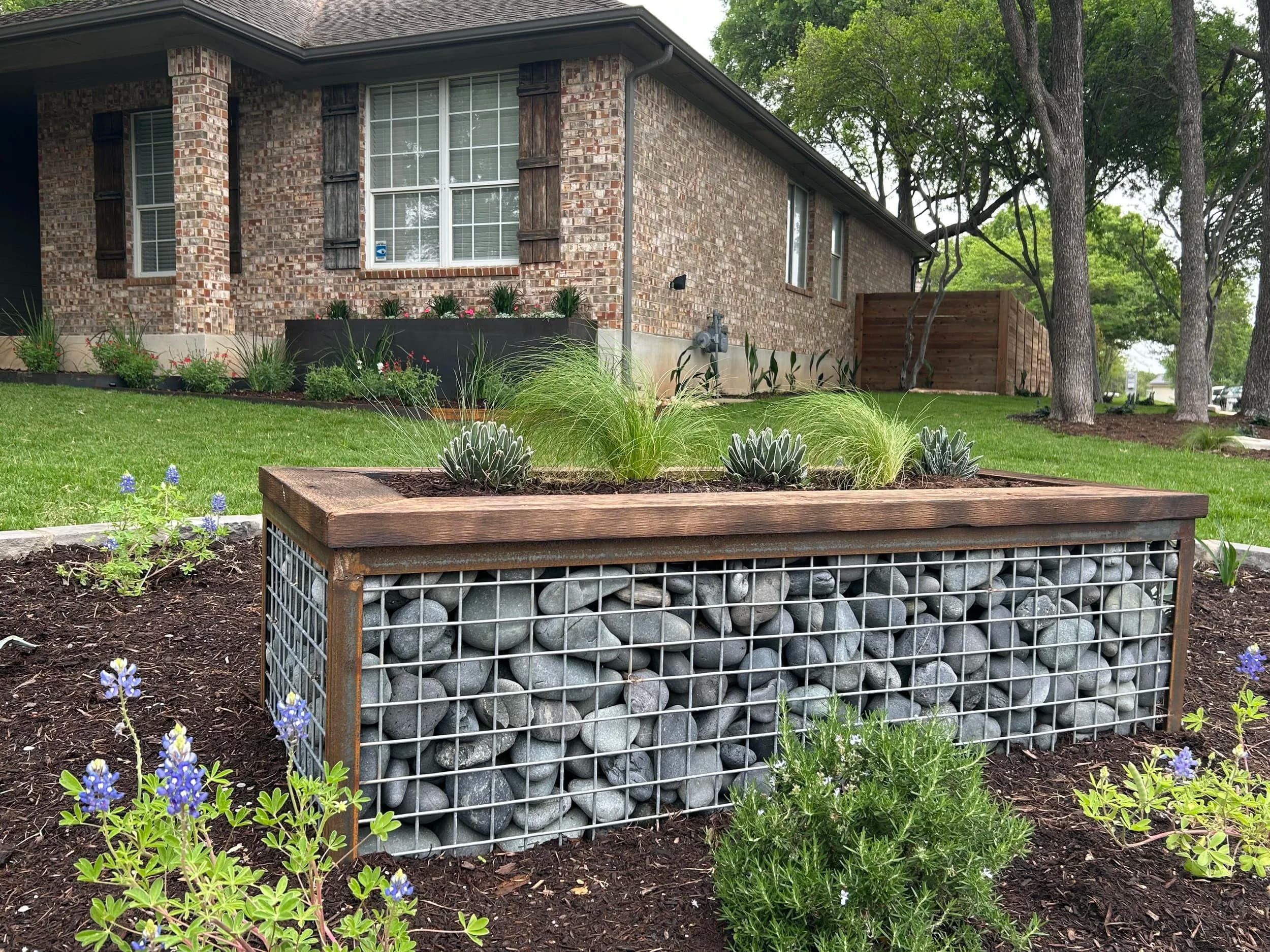
The raised bed strategy is often the best answer: For vegetable gardens, perennial beds, roses, or any plants that need good drainage and deep soil, raised beds filled with quality loam mix completely bypass the caliche issue. A 16–18 inch raised bed sits entirely above the caliche layer, gives roots ample room, and can be designed with whatever soil mix the plants need. This is what we often recommend for the ornamental garden areas of a landscape on a caliche-heavy property.
Landscaping Strategies That Work Over Caliche
18+ in raised bed height bypasses most caliche layersThe best approach to landscaping on a caliche property isn't fighting the geology, it's designing around it intelligently. Here are the strategies we use most frequently.
Raised Beds, Most Reliable for Ornamentals and Food Gardens
Building up rather than digging down bypasses caliche entirely. A 16–18 inch raised bed filled with a quality loam mix (30% expanded shale, 30% compost, 40% sandy loam) gives plants excellent drainage, deep rooting room, and soil chemistry you control. On a caliche property, raised beds are the right choice for vegetables, herbs, roses, and any ornamentals that need acidic or well-drained soil conditions. See our custom planters and raised beds service for what's possible.
Berming and Soil Building for Trees
For trees you want to plant on caliche soil, create a broad, shallow berm (12–18 inches high, 6–8 feet in diameter) of amended soil above the caliche layer. The tree's roots will establish primarily within this berm. Select tree species that tolerate the conditions below, native trees that have evolved on caliche soil are the best candidates.
Surface Drainage Redesign
If your caliche is causing a drainage problem (perched water table, standing water), redesign your surface drainage rather than trying to create drainage through the caliche. Grade the yard to drain surface water away before it saturates the soil above the caliche layer. Dry creek beds and surface swales direct water to outlets before it has a chance to back up. French drains can intercept surface water and route it laterally to a daylight outlet.
DG and Gravel Mulch for Xeriscape Plantings
On caliche-heavy areas where you want low-water xeriscape plantings, a DG or gravel mulch surface (2–3 inches) combined with native plants creates a beautiful, low-maintenance landscape that requires no soil amendment. The gravel mulch reflects heat, reduces moisture evaporation, and doesn't hide the caliche problem, it just doesn't need to fight it.
Containers Where In-Ground Planting Isn't Feasible
For properties with severe near-surface caliche, custom steel planters provide a fully controlled growing environment. We've designed planter systems for clients where the native soil was essentially unusable, the planters become the garden.
Plants That Thrive in Austin Caliche Soils
pH 8.0–8.5 in caliche-affected soilThe best approach to caliche is not fighting it, it's selecting plants that evolved in exactly these conditions. Central Texas has a rich flora of native species that have been living on shallow, alkaline, caliche-prone soils for thousands of years.
Native Trees for Caliche Soils
- Texas Mountain Laurel (Sophora secundiflora), iconic Hill Country native, intensely fragrant purple flowers in spring, handles shallow caliche soils beautifully
- Desert Willow (Chilopsis linearis), stunning trumpet flowers, adapted to rocky caliche soils and dry conditions
- Eve's Necklace (Sophora affinis), small native tree, handles both clay and caliche
- Texas Persimmon (Diospyros texana), multi-trunk small tree, native to the Hill Country limestone/caliche belt
- Anacacho Orchid Tree (Bauhinia lunarioides), Hill Country native, beautiful orchid-like flowers, thrives on rocky caliche
Native Shrubs and Perennials
- Texas Sage / Cenizo (Leucophyllum frutescens), drought-adapted, blooms after rain, perfectly suited to alkaline caliche soils
- Agarita (Mahonia trifoliolata), native thorny shrub, yellow flowers, red berries, thrives on caliche
- Blackfoot Daisy (Melampodium leucanthum), blooms almost year-round, prefers well-drained alkaline soil
- Mealy Blue Sage (Salvia farinacea), native sage, excellent drought and alkaline tolerance
- Antelope Horn Milkweed (Asclepias asperula), native milkweed for monarchs, adapted to caliche and rocky soils
- Century Plant (Agave americana) and smaller agave species, iconic and utterly caliche-tolerant
What Consistently Fails on Unmodified Caliche
- Azaleas and rhododendrons (need acidic, well-drained soil)
- Japanese maples (need deep soil, consistent moisture, acidic conditions)
- Most vegetables (without raised beds)
- Roses (can survive but struggle without significant amendment)
- Bluegrass, fescue, or any cool-season grass
The ACL approach on caliche properties: We design with the caliche as a given, not an obstacle. Native plants near the foundation and in open landscape areas. Raised beds for ornamentals, vegetables, and non-native plants the client wants. Strategic caliche breaking only for trees and feature plantings where the investment is justified.
For a broader look at Austin's soil challenges, read our guide on clay soil and its effects on your landscape and foundation.
Schedule a free consultation and we'll assess your soil conditions, identify any caliche layers, and design a landscape strategy that works with your property's natural geology.
Frequently Asked Questions
What is caliche soil and do I have it in my Austin yard?
Why are my plants dying in my Austin yard even though I water them?
How do I break through caliche in my yard?
What plants grow best in caliche soil in Austin?
How deep are raised beds for landscaping over caliche?
Does caliche cause drainage problems in Austin yards?
Related Services
Related Articles
Have Caliche or Drainage Problems on Your Property?
We assess soil conditions, including caliche depth and extent, on every property we design for. Tell us about your yard and we'll build a plan that works with your soil, not against it.
Founder, Austin Creative Landscaping